

29/06/2026
How TechCloud ERP Actually Helps You Scale Without the Chaos
View More
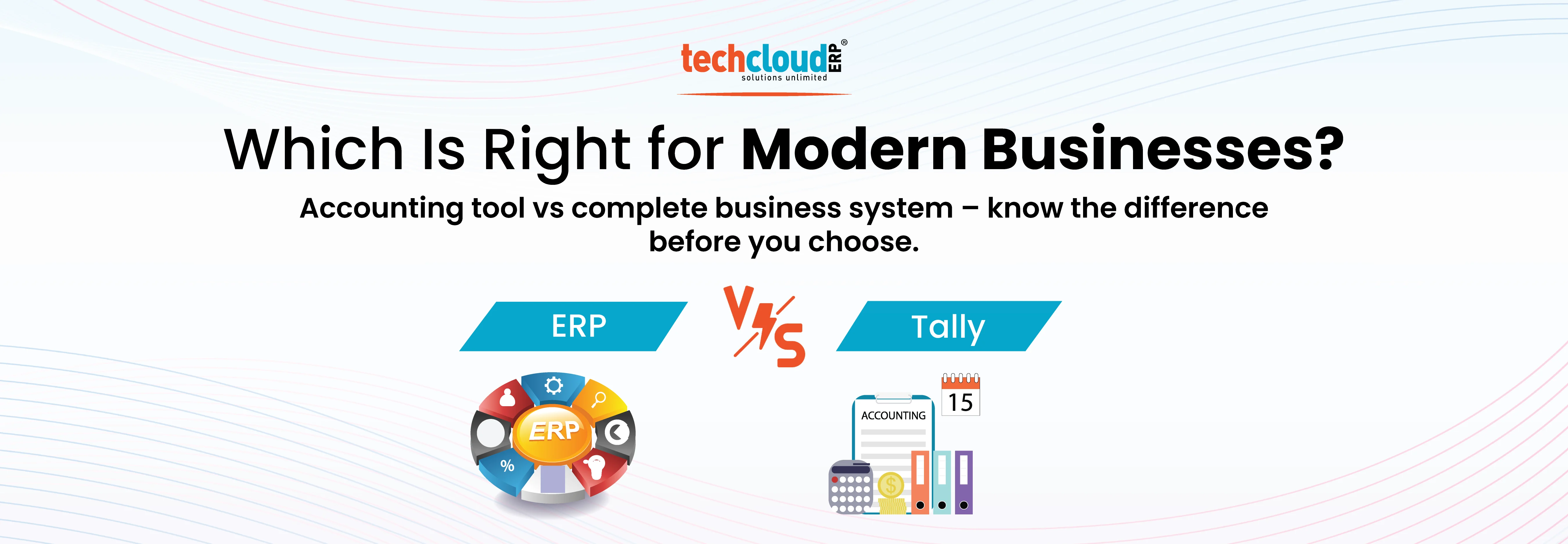
For many businesses in India, Tally solutions are the first step toward digital accounting. It’s simple, familiar and works well for basic bookkeeping, GST compliance and financial reporting. Small businesses and startups rely on it because it helps manage day-to-day operations without requiring complex risk.
However, as a business grows, operations become more connected. Sales, inventory, purchase and finance need to work together. When information is spread across different tools and teams, it becomes harder to maintain visibility. This is where ERP software begins to play a larger role by connecting different departments into a one single system.
In the early stages, companies focus mostly on managing accounts and compliance. But as the company expands, the number of transactions, departments and locations also increases. Teams begin to rely on multiple systems or manual coordination to keep operations running.
Over time, this creates delays in reporting and makes it difficult to track the complete business picture. With proper ERP implementation, organizations can centralize processes and ensure that every department works with the same real-time information.
In many growing businesses, accounting data remains separate from operational activities like sales, inventory and purchase. This lack of integration makes it difficult for management to get a complete view of business performance.
When systems are not connected, teams rely on emails, spreadsheets, or calls to share updates. This manual coordination slows down work process and increases the chances of miscommunication.
Because information is stored in different systems, preparing reports most of takes longer. Main head may need to collect data from multiple teams before making important business decisions.
As businesses expand to new branches or warehouses, tracking operations from a single system becomes challenging. Without centralized visibility, monitoring performance across locations becomes time-consuming and less accurate.
Tally focuses mainly on accounting processes, while ERP systems support end-to-end business management. Businesses looking at top 10 ERP solutions often consider them because they integrate multiple functions into one platform.
When systems are connected to each other, managers can see business performance instantly instead of waiting for reports. ERP platforms also introduce structured workflows that improve efficiency through ERP automation, helping companies reduce manual work and improve collaboration.
ERP connects different departments like sales, purchase, inventory, finance and HR into one unified platform.
Management teams can access dashboards and insights instantly instead of waiting for periodic reports.
Cloud-based ERP systems allow teams to access business data from anywhere and anyplace.
Get approvals, reporting and internal processes can be automated to improve efficiency and workflows get control.
Tally has supported businesses for many years and remains a reliable solution for basic accounting. However, as companies grow, they require better coordination between departments and quicker access to business insights. ERP systems address this by integrating operations and improving decision-making. For growing businesses, adopting ERP is not just about replacing accounting tools but about building a stronger operational foundation for long-term growth.
Yes. Tally remains a reliable solution for accounting, taxation and financial reporting. Many small businesses use it effectively when their operations are limited to basic accounting needs.
Businesses usually consider ERP when they need better coordination between sales, purchase, inventory, finance and operations, especially when managing multiple teams or locations.
ERP systems include accounting as one of their core modules, but they also extend beyond it by managing business operations, workflows and reporting within a single platform.

